
Menu
Sustainable Architecture in Practice: 6 Inspiring Eco-Building Projects
Sustainable architecture has grown into an essential part of the design process. Architects are increasingly challenged to design buildings that are not only aesthetically pleasing and functional, but also contribute to a healthier living environment and a lower ecological impact.
Eco-building plays an important role in this. This design approach considers the entire life cycle of a building: from material extraction and design to use, maintenance, and future repurposing. By consciously choosing natural materials, energy-efficient strategies, and a strong relationship with the landscape, architecture emerges that is truly future-proof.
In this blog, we highlight six inspiring projects in which sustainable architecture, biobased materials, and natural integration with the environment take center stage.
What is the difference between eco-building and traditional construction?
Eco-building focuses on the entire life cycle of a building, from design to reuse. It uses sustainable, renewable materials and emphasizes energy efficiency, health, and minimal environmental impact. Traditional construction often takes these aspects less into account, which can result in a greater environmental impact and a building whose long-term value is less stable.
Is Shou Sugi Ban low-maintenance?
Yes, thanks to its charred surface, Shou Sugi Ban is naturally protected against moisture, insects, mold, and UV radiation. As a result, the wood has a long lifespan and periodic treatments are unnecessary, which helps keep maintenance costs low.
Which type of wood is used for eco-building with Shou Sugi Ban?
At Zwarthout | Shou Sugi Ban, we exclusively use FSC-certified wood from sustainably managed forests. The choice depends on the desired appearance, application, and technical building requirements. Each wood species is carefully selected for its quality and durability.
Read more here about suitable wood species for Shou Sugi Ban.
What applications is eco-building with Shou Sugi Ban suitable for?
Shou Sugi Ban is ideal for façade cladding and exterior walls. It is also used in landscape architecture, interior construction, and even furniture design. The technique offers both functional and aesthetic advantages.
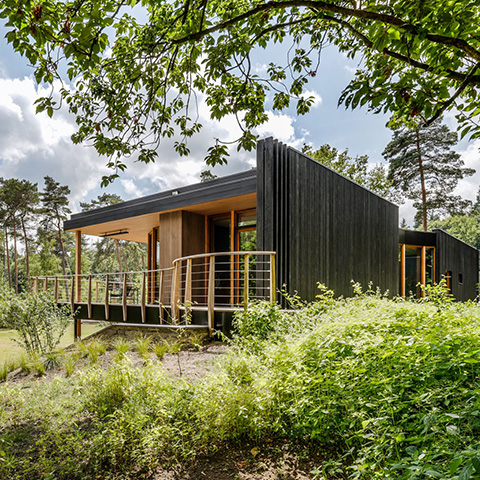
1. Modern Biophilic Country House – Architecture that Enhances Well-Being
Biophilic design is playing an increasingly important role in sustainable architecture. This modern country house on the Utrechtse Heuvelrug was designed to create a strong connection between residents and nature.
Architect Steven van Leeuwen (ORGA architects) collaborated with landscape architect Nico Wissing on a design in which natural materials and organic forms take center stage.
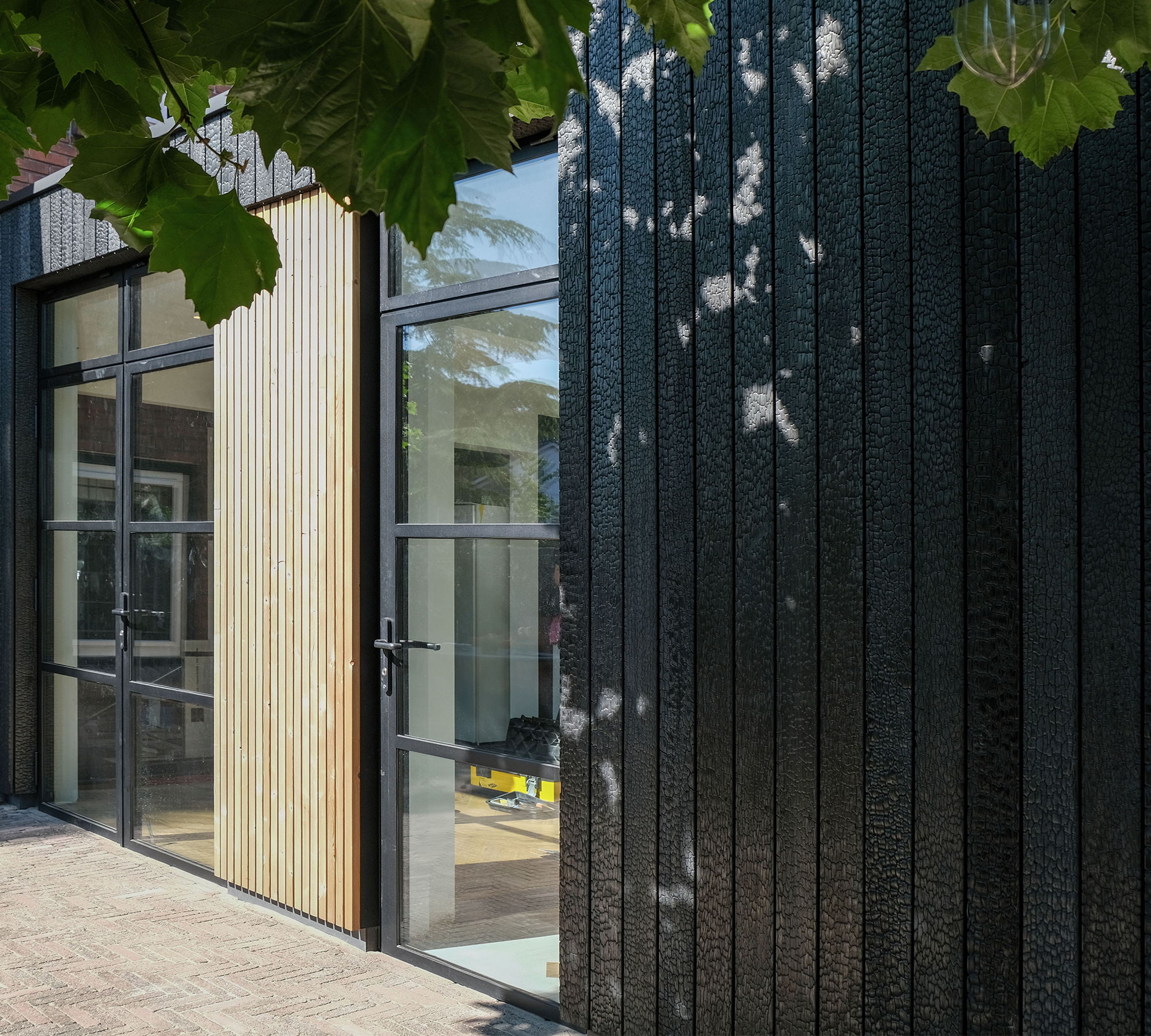
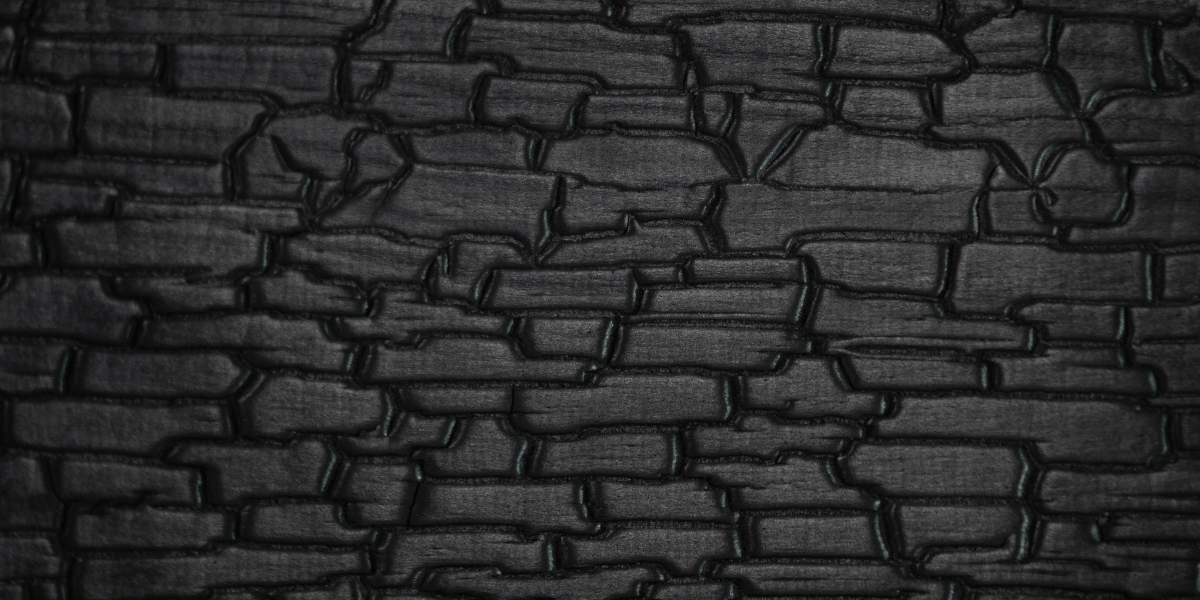
Wood plays an important role here. At the rear of the house, Marugame façade cladding was applied. Its refined scale-like texture and silvery sheen perfectly complement the Fraké wooden façades, terraces, and balustrades.
The result is a home that is not only sustainable but also promotes tranquility, well-being, and a sense of connection with nature.
- Architect:ORGA architect
- Landscape architect:Nico Wissing
- Constructor :Bouwbedrijf Van Engen
- Photograph:Robert Koelewijn Fotografie
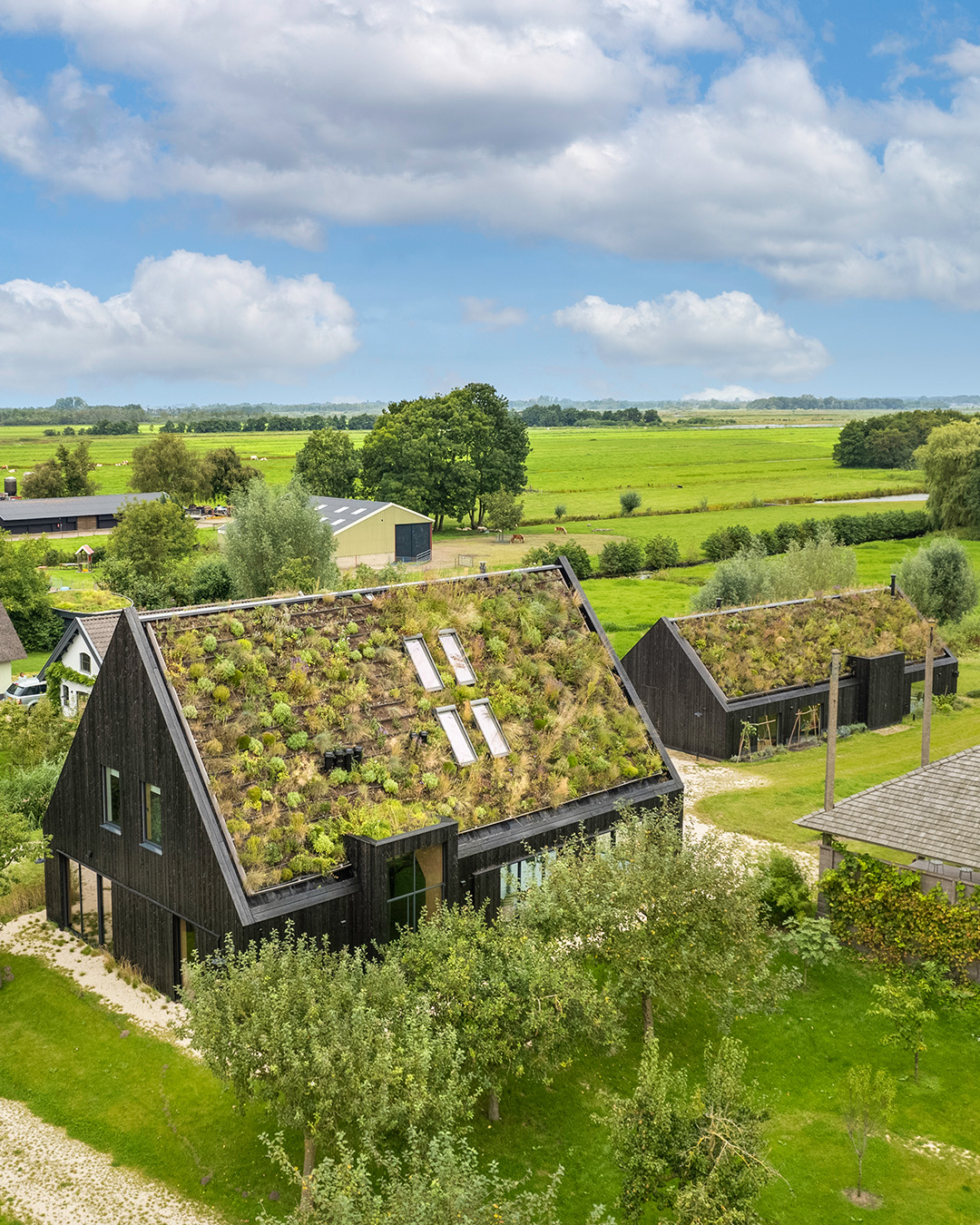
2.Rural Property in Westbroek – Architecture in Dialogue with the Landscape
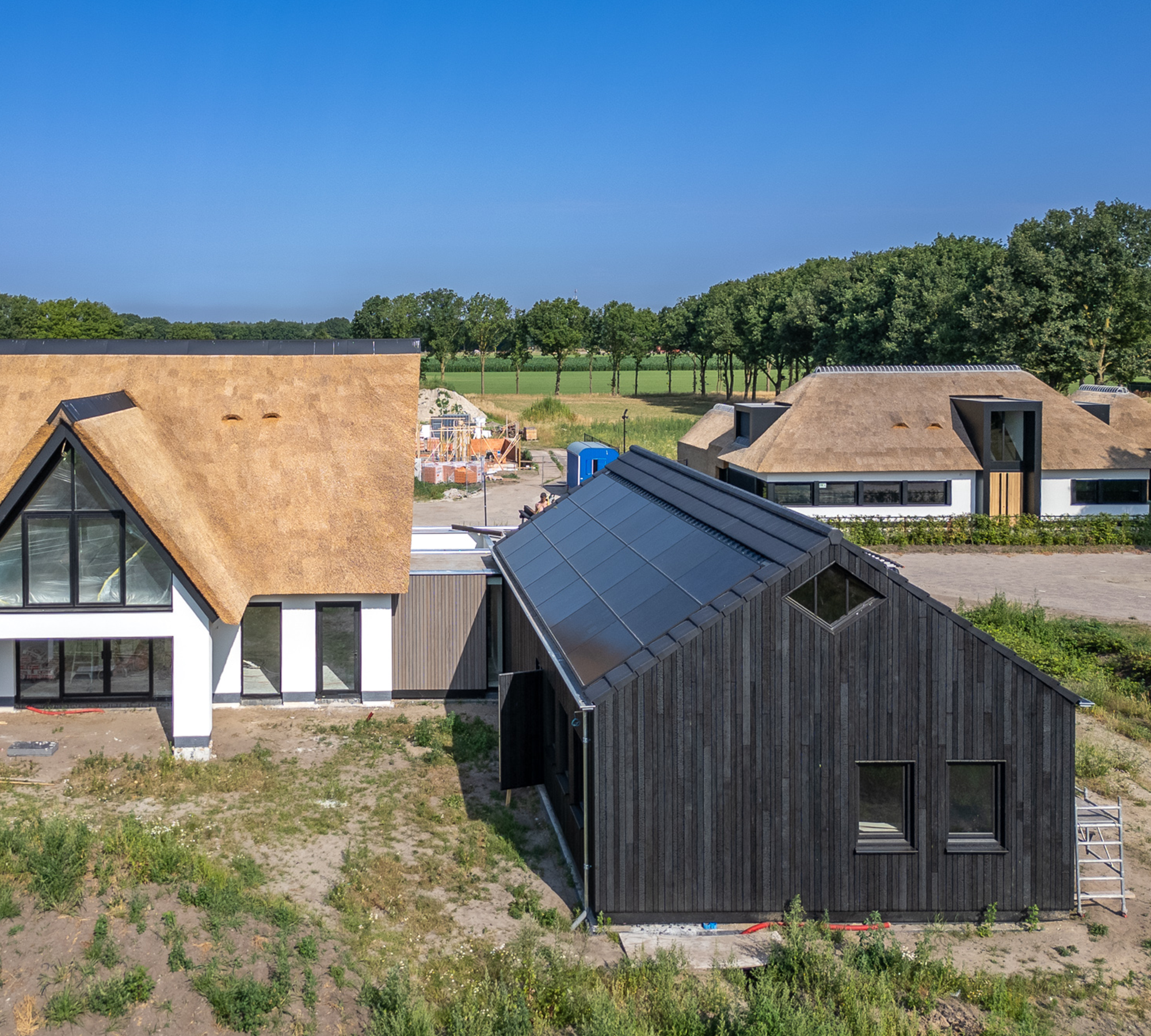
For a spacious plot in the rural village of Westbroek, ORGA architects designed a completely new residential environment. The main house, featuring an impressive 10-meter-high timber frame structure, forms an architectural ensemble together with an auxiliary building that has been carefully positioned within the landscape.
Natural and contemporary materials were used for both the façades and roof edges. Both roofs are covered with green vegetation, which is not only aesthetically appealing but also contributes to biodiversity, water retention, and thermal insulation.
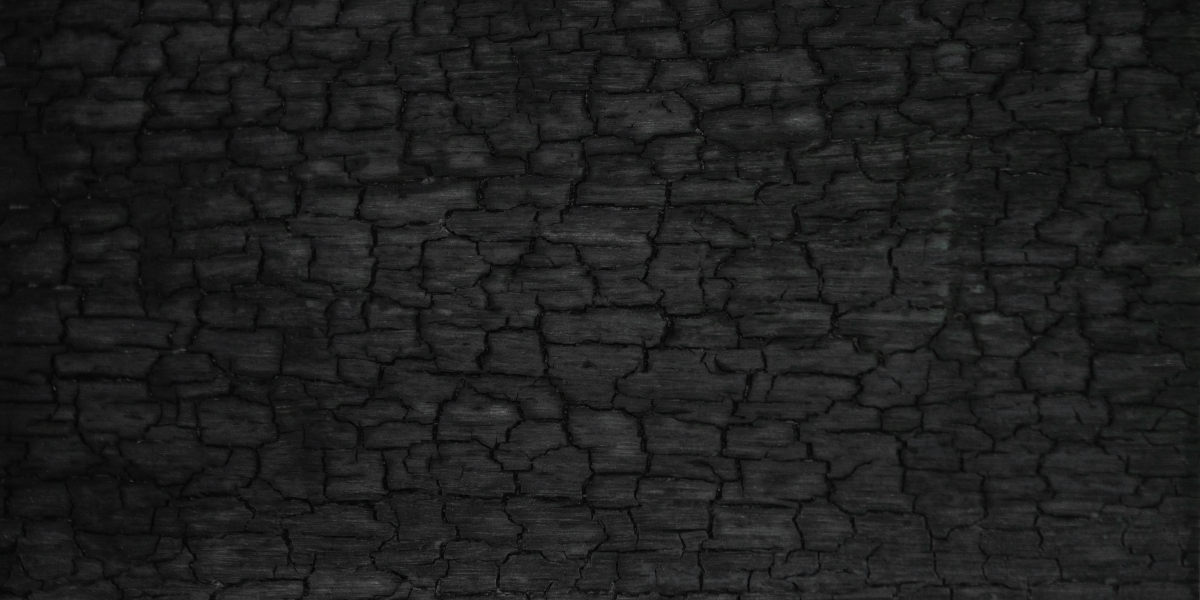
Two variants of Shou Sugi Ban were used for the façade cladding: Marugame and Naoshima. The characteristic pattern of Naoshima is visible on both the house and the outbuilding, emphasizing the natural strength of the material.
The result is a project in which architecture, landscape, and material use come together in balance.
- Architect: ORGA architect
- Constructor:Bouwbedrijf van Engen
- Photograph :wij-zien.nl
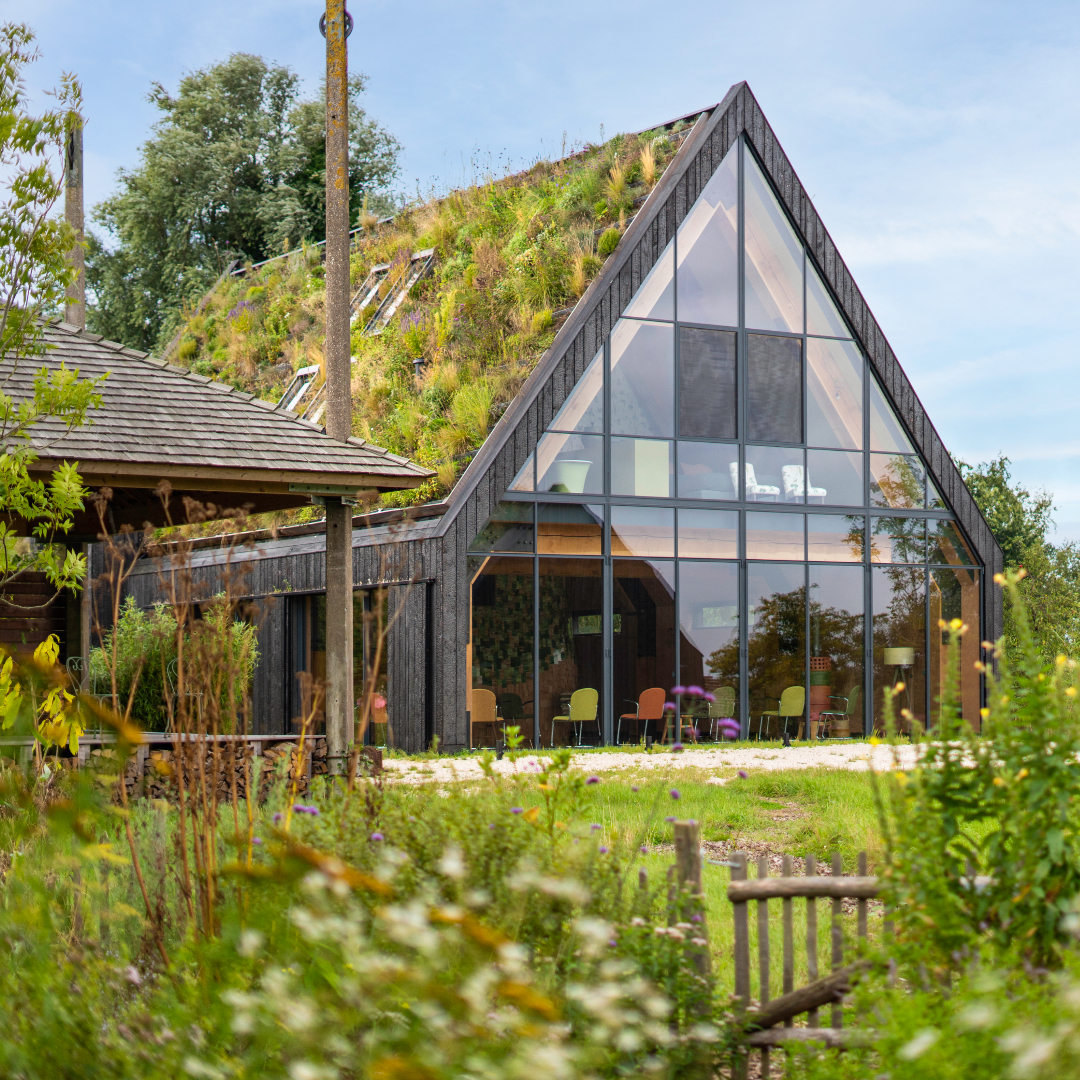
3. Biobased Forest House in Stameren – Building with Natural Materials
In the Stameren forest near Maarn stands a house designed entirely from its relationship with the surrounding landscape. The home is located at the transition between forest and heathland, giving each side of the house a different spatial experience.
On the forest side, the house feels sheltered and intimate. On the heathland side, large glass façades open toward the landscape, providing abundant daylight and panoramic views.
The architects from ORGA deliberately chose biobased materials, including a façade made of charred Douglas wood (Naoshima). These natural materials strengthen the connection with the environment and contribute to a sustainable and healthy living climate.
This project demonstrates how sustainable architecture and landscape integration can reinforce each other.
- Architect : Steven van Leeuwen – ORGA architect
- Constructor: Bouwbedrijf van Engen
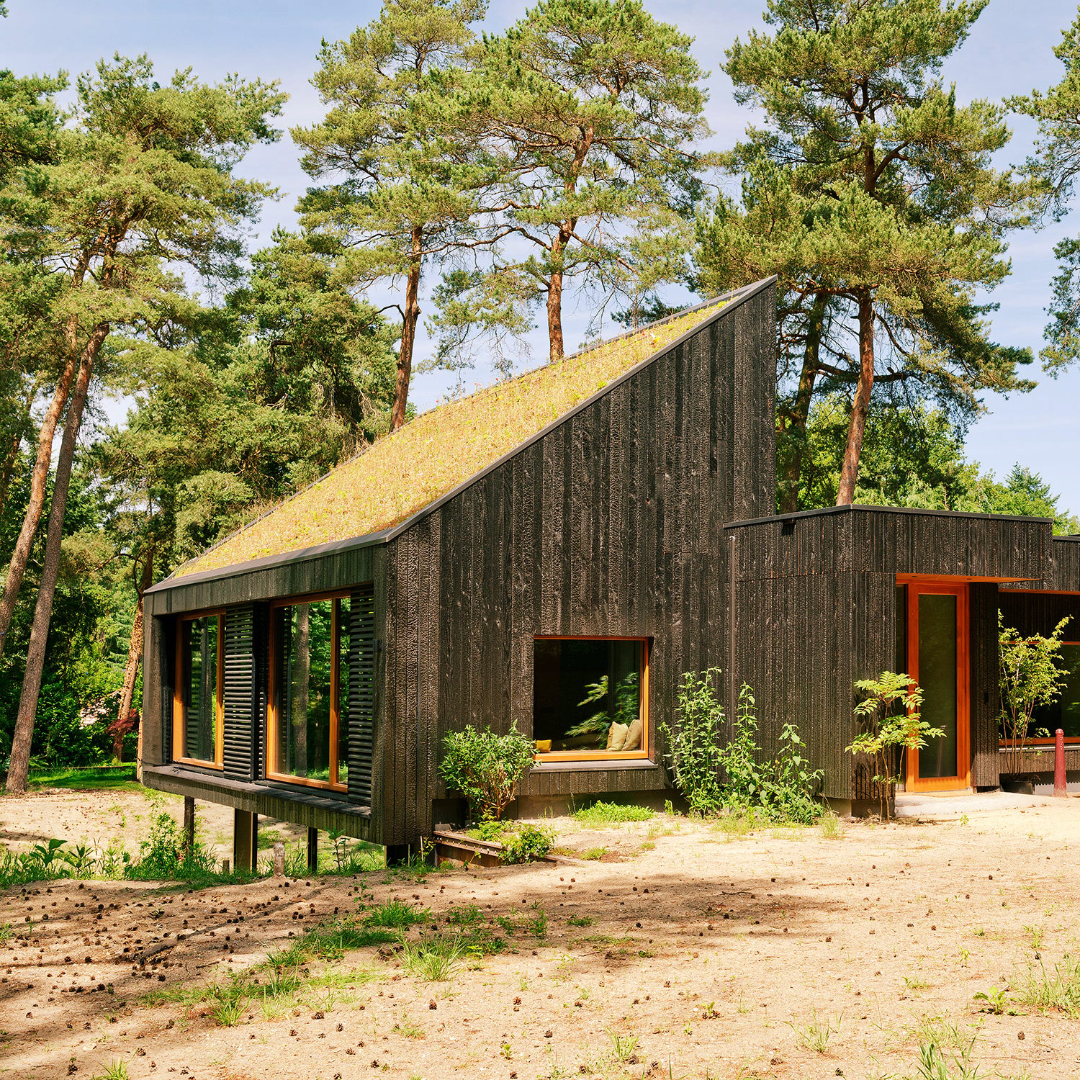
4. Barn House in Deventer – Minimalist Barn Architecture
The barn house is a well-known archetype within contemporary sustainable architecture. In Deventer, a minimalist Finnhouse barn residence was realized in which simplicity and natural materials are central.
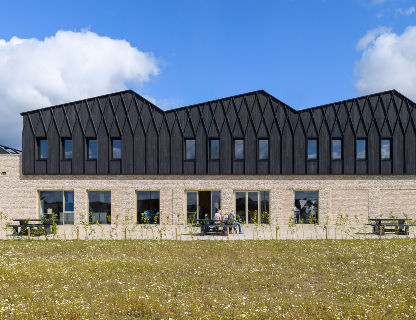
The building combines a green roof with Marugame façade cladding, creating a strong yet calm architectural expression. The wooden window frames are deliberately accentuated so that the openings in the façade receive extra emphasis.
On the garden side, there is a covered terrace that creates a smooth transition between indoors and outdoors. In this way, the home forms a harmonious whole with its natural surroundings.

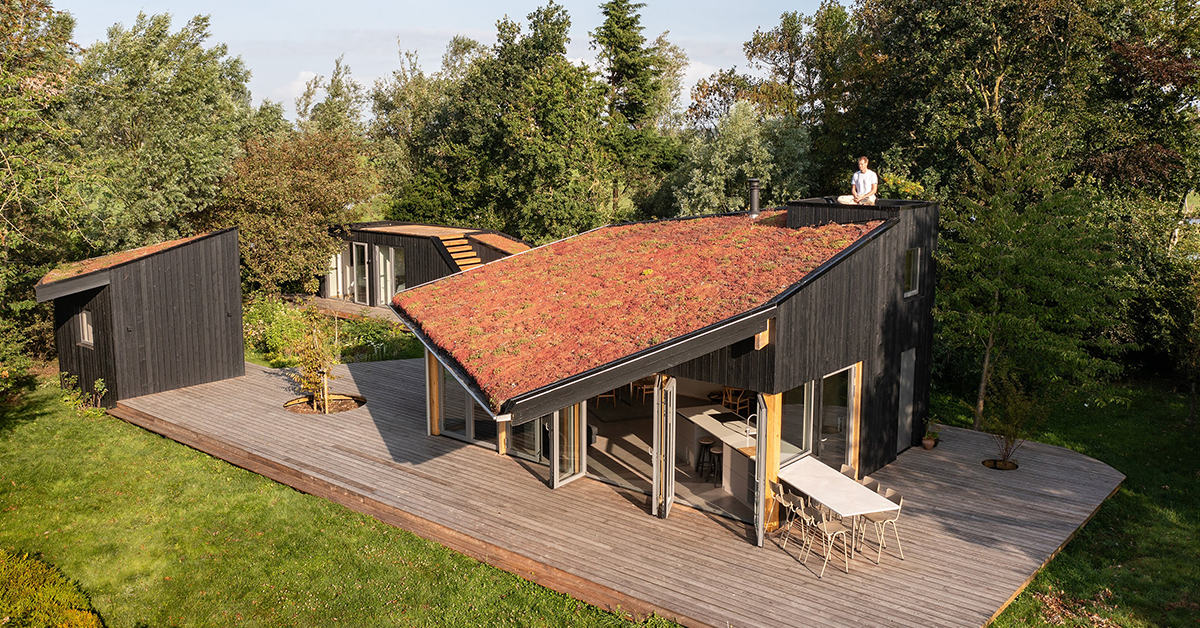
5. Holiday Home Schermerland – A Place for Peace and Relaxation
Surrounded by water and nature, this special holiday home is located in Schermerland. The design focuses entirely on relaxation and the relationship between indoor and outdoor spaces.
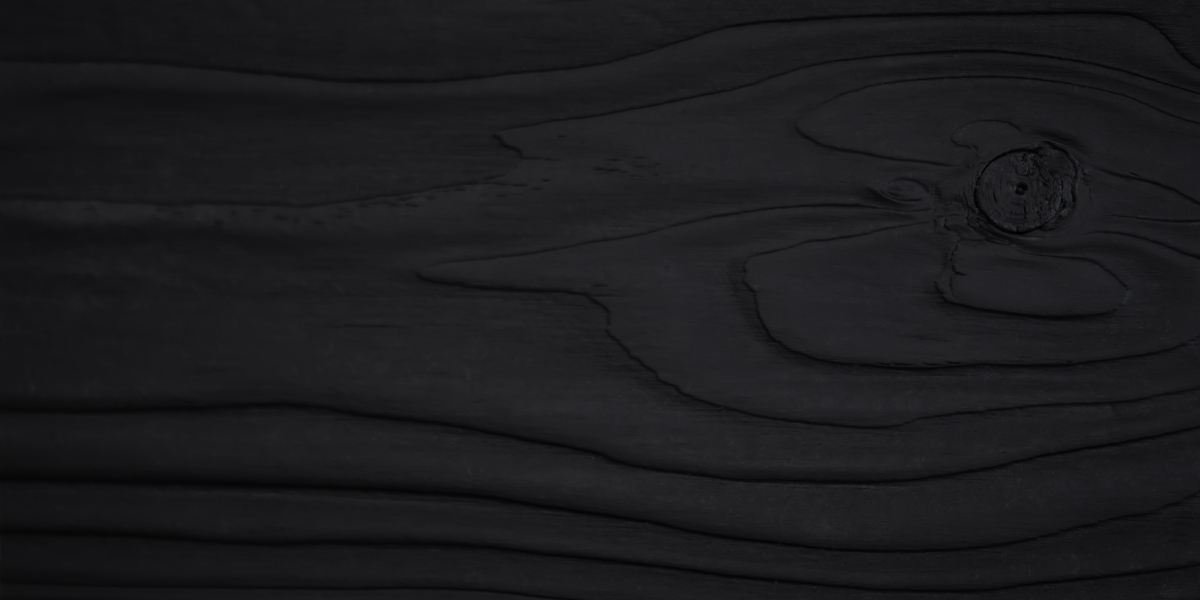
The house consists of three separate volumes that together form one architectural composition. By using the same façade cladding (Shodoshima) for all volumes, visual unity is achieved.
A special element of the design is the yoga room, created specifically to support calmness and mindfulness.
Inside and outside flow seamlessly into one another. For example, a long table extends from the kitchen to the terrace and garden, allowing the landscape to become part of the daily use of the house.
- Architects: Caspar Schols, Quentin Martin, Ludvig Holmen, Daria Nepop
- Constructor: Siem Woetsenburg
- Photograph: Jorrit ’t Hoen
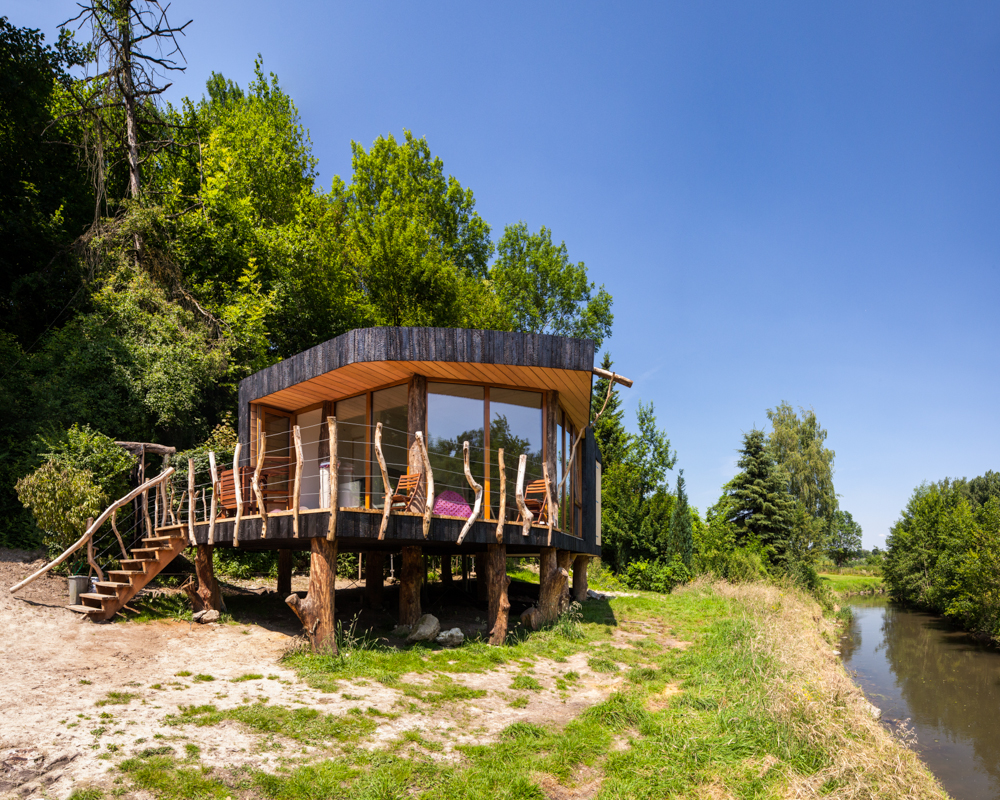
6. Idyllic Geul Riverbank – Climate-Adaptive Building
Architects Pieter Weijnen and Mark Spijkerman, in collaboration with contractor WHD Interieurbouw and Goof Weijnen, realized a home at an idyllic location along the Geul River that fully responds to the dynamics of the landscape.
Because the area regularly floods, the house was built entirely on tree-trunk constructions, elevating it high above the water level. In addition to having no CO₂ footprint, the home literally has no footprint on the ground.
The design is energy-neutral thanks to:
- solar collectors for hot water
- solar panels for electricity
- a helophyte filter for water purification
The structure consists of Kerto beams, SLS beams, and wooden I-beams. Cellulose was used for insulation, and the façade is finished in Robinia wood with a Naoshima Shou Sugi Ban finish.
This project demonstrates how sustainable architecture can also offer solutions for climate adaptation and changing landscapes.
- Architect : Pieter Weijnen & Mark Spijkerman
- Constructor :WHD Interieurbouw, Goof Weijnen
- Photograph :IC4U & Hans Peter Föllmi
Sustainable Architecture as a Strategy for the Future
The projects in this blog show that sustainable architecture is much more than energy efficiency. It is an integrated design approach in which material choices, landscape, health, and longevity come together.
For architects, this means designing from a broader vision:
- building with natural and biobased materials
- designing with respect for the environment
- integrating biodiversity and water management
- choosing materials with a long lifespan
Techniques such as Shou Sugi Ban show how traditional knowledge and modern architecture can strengthen each other. By naturally protecting wood through charring, a durable façade solution is created that is aesthetic, low-maintenance, and circular.
The future of architecture lies in buildings that are not only beautiful but also contribute to a healthy living environment and a sustainable built world.

FAQ
Laatste reviews
De “Paradox”. Hout verbranden om het te beschermen. Klinkt tegenstrijdig maar is geniaal.
Bij ORGA zijn we nogal fan van biobased materialen die zichzelf bewijzen. Neem nu onze samenwerking met Zwarthout | Shou Sugi Ban. Door hout volgens de eeuwenoude Shou Sugi Ban techniek te branden, ontstaat er een natuurlijke beschermlaag die geen verf of chemicaliën nodig heeft.
Zo ontstaat een gevel met karakter die generaties meegaat. Bij de drie recente projecten hebben we gezien dat het zorgt voor robuuste, tijdloze uitstraling, terwijl het tegelijk bijdraagt aan mooie, hoogwaardige architectuur.
Minder onderhoud, wel een gebouw dat met de jaren alleen maar mooier wordt. Dat is volgens ons pas echt toekomstbestendig ontwerpen.
We zijn heel erg blij met de uitstraling van ons huis in Zunderdorp.
Het zwarte hout in combinatie met het zwart zink en de betonnen plint
maakt de buitenkant van ons huis erg spannend.
De brede en smalle planken hebben we afgewisseld met de smalle vierkante balkjes, waardoor er geen herhaling in het patroon zit. Het relief wat zo is ontstaan, voegt toe aan het gehele ontwerp. De zwarte vlakken tussen de groene bomen zorgen voor een rustig eindresultaat. Hier genieten we enorm van!
Voor ons sustainable Simmerhûs op Terschelling gingen we als opdrachtgevers de samenwerking aan met Team V Architectuur, Vreeker B.V., Koninklijke Tichelaar en ontwerpduo Kranen/Gille. Het resultaat hiervan is een volledig duurzaam en uniek onder architectuur gebouwd huis dat met de hulp van vele partijen als een gesammtkunstwerk tot stand is gekomen.
Een van de beeldbepalende elementen is de gevel van Zwarthout | Shou Sugi Ban geworden. Opvallend en tegelijkertijd bescheiden, echt anders maar ook passend binnen de omgeving. Een kwalitatief hoogwaardig en duurzaam materiaal met een tijdloze uitstraling. Origineel en in het oog springend maar op een natuurlijke manier die naadloos aansluit bij onze visie. Heel blij met jullie bijdrage!
Bij Quist Wintermans Architekten vinden we dat een goede samenwerking de mooiste resultaten kan opleveren. Zo was ook onze samenwerking met Zwarthout zeer fijn.
De gevels van de dienstgebouwen van ‘’De Groene Boog’’ in Rotterdam zijn door het montageteam van Zwarthout | Shou Sugi Ban bekleed met de gebrande bamboe met brandklasse B-s1,d0 : Yoroi.
Wij hebben voor een opdrachtgever de bestaande gevelbekleding van een woonhuis vervangen voor Marugame gevelbekleding, een combinatie met planken en balkjes. Dit geeft een heel mooi en gaaf eindresultaat.
Het is een heel mooi en makkelijk verwerkbaar product. Je wordt goed geholpen en ze zijn erg betrokken, top service.
”Wij hebben gekozen voor Yoroi om meerdere redenen. Allereerst houden we van de Japanse klassieke techniek die is toegepast voor het branden van de bamboe. Door de brandtechniek Shou Sugi Ban heeft Yoroi een brandklasse B en is onderhoudsvrij. Tot slot is de zwart gebrande bamboe een hergroeibaar materiaal en sluit esthetisch gezien perfect aan bij ons ontwerp.”
”Als hovenier is het een eer om met zulke mooie traditionele producten te kunnen werken.
Ook de levertijden zijn prima en je wordt vriendelijk geholpen.”
“Wij hebben het gepotdekselde hout van onze stolp-boerderij in de Beemster onlangs vervangen door Shodoshima semi-gloss van Zwarthout l Shou Sugi Ban. Met speciale planken van 25 cm breed pakt het prachtig uit op een boerderij. Een heel mooi product en super service van Zwarthout l Shou Sugi Ban!”